The Trueform Single Diamond Explained
How we collapsed the design and development process into one continuous motion, and why it makes everything faster.


Most studios and agencies still work in two diamonds. We work in one.
That sounds like a small distinction. It isn't. It's the difference between a process built for a world where design and engineering were separate disciplines, and a process built for the way the best digital work actually gets made today. The Single Diamond is how we describe the second one. It's not a metaphor we borrowed, it's the shape our work already makes since several years.
Here's what it means, and why it matters for what you're trying to ship.
Where the two diamonds came from
If you've spent any time around design teams, you've seen the Double Diamond. It's the Design Council's classic model, taught in every design school and reproduced in every consultancy deck: Discover, Define, Develop, Deliver. Two diamonds sitting side by side, each one widening out into possibility and then narrowing back down to a decision.
It's a genuinely good model, for the world it was built in. And in that world, there were two completely separate creative phases. First you designed the thing, usually in Sketch or Figma. Then, much later and often with a different team, you built the thing in code. Two diamonds, because there were two distinct acts of creation, separated by a wall.
That wall has a name. It's called the handoff.
The second diamond is a tax
Every Double Diamond process carries a hidden cost, and it lives in the gap between the two diamonds.
You design a beautiful interface in one tool. Then you hand it to a different team, who rebuilds it from scratch in another. Things get lost in translation. The spacing drifts. The interactions that felt effortless in the prototype turn into a backlog of tickets. The animation that made the page sing never quite survives the rebuild. What launches is a negotiated approximation of what was designed, and getting even that far took weeks of back-and-forth that produced nothing the user will ever see.
The second diamond isn't where the value gets created. It's where the value gets recovered after the handoff lost some of it. It exists to manage a separation that doesn't need to exist anymore.
So we removed it
The Single Diamond is the claim that those two diamonds collapse into one, because for us, design and engineering aren't separate phases.
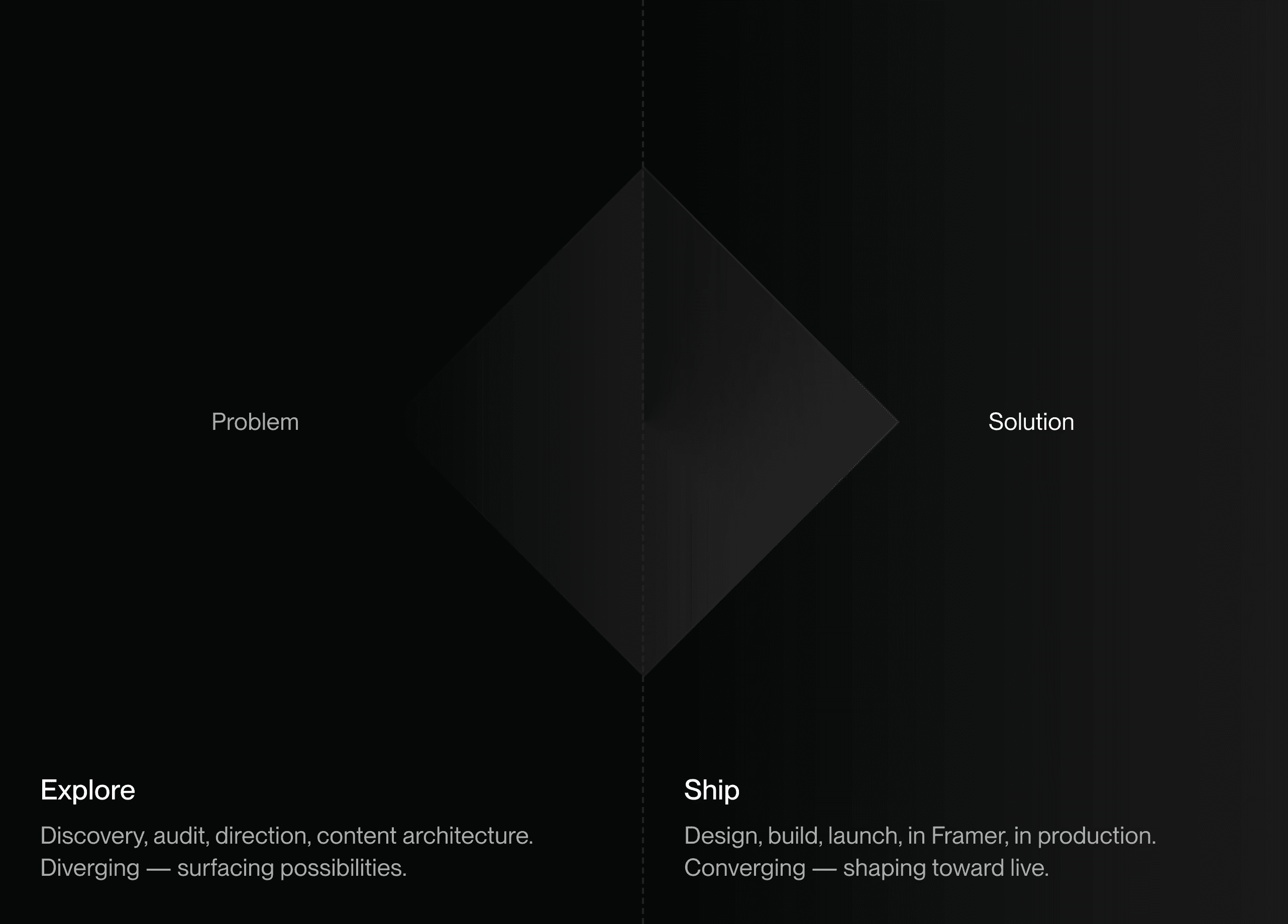
We design where the site actually lives. The work happens in Framer, in production, from the start. There's no Figma file to rebuild, because the thing we're designing is the thing that ships. Exploration and delivery happen in the same motion, in the same environment, by the same people. The wall is gone, and so is the tax that came with it.
One diamond. Two phases. Explore, then ship.
The two phases
Explore. The left half of the diamond: The part that widens out. This is where we surface possibilities before committing to any of them: kickoff, audit, content architecture, strategic direction. We dig into what your buyers actually need, where your current site is quietly leaking pipeline, and where the brand has drifted from where it should be. This phase is fast and deliberate, roughly one working week (or two). At the end of it, you don't get a deck. You get directions.
Ship. The right half: The part that converges toward something live. Design and build happen together, in Framer, in production. Pages come together day by day, in front of you, not behind a wall. No rebuild. No handoff between a design team and a dev team, because there isn't a seam to hand across. Performance, SEO and AEO are baked in as we go, not bolted on at the end. We launch and hand off a site your team owns and can run themselves. Depending on scope, this takes two to six weeks.
That's the whole shape. Discovery used to be Discover plus Define; we fold both into Explore. Delivery used to be Develop plus Deliver, split across two teams; we fold both into Ship, in one environment. Four phases become two, because the separations that justified four no longer apply.
What this actually buys you
The Single Diamond isn't a branding exercise. It changes the things you care about:
It's faster, because the slowest part of a traditional build, the rebuild, simply doesn't happen. Kickoff typically lands within five business days, and the work moves continuously from there.
It's more faithful, because nothing gets lost in translation between design and build. What you approve is what goes live, down to the interaction.
And it's yours to keep. Because everything is built in Framer, your team can update content, launch new pages, and run the site without filing a developer ticket every time. The independence is built in, not promised for later.
Most studios will sell you two diamonds and call the second one rigor. We think the second diamond is mostly the cost of working the old way. So we got rid of it.
Explore. Ship. One diamond.


