

Trueform won the Framer Best Big Site 2025 Award with Miro
We won the most demanding category in Framer's 2025 awards with miro.com, a site that runs across hundreds of pages and dozens of locales without feeling heavy. Here's how we did it, and why a Framer-native studio is the only kind that could have.

Trueform won the 2025 Framer Best Big Site Award with miro.com. It's the category Framer reserves for sites at real scale, the ones where the design has to hold up across hundreds of pages, multiple locales, and a marketing team that ships every week. We took on the largest project of our year and made it feel light.
This is the story of how a Framer-native studio won the most demanding category in Framer's 2025 awards, and what it says about where B2B SaaS websites are heading.
What is the Framer Best Big Site Award?
The Framer Best Big Site Award recognizes the year's strongest large-scale website built on Framer. "Big" is the operative word: this category isn't about a beautiful one-pager or a clever product launch site. It's about sites that handle real complexity, including many pages, deep navigation, localized content, CMS-driven systems, and the operational reality of a marketing team that needs to keep shipping after launch.
The 2025 Framer Awards spanned 10 categories with $100,000 in total prizes. Winners receive $10,000 in cash, an aluminum trophy, and a permanent spot in Framer's hall of fame. Best Big Site is the category where craft has to survive contact with scale, which is exactly what makes it the hardest to win.
Why Miro chose Framer (and why it matters)
Before we get to the work, the context: Miro is one of a growing list of category-defining B2B SaaS companies, alongside Perplexity, Scale AI, Cal.com, and Mixpanel, that have moved their primary marketing surface to Framer. The reason is the same in every case: shipping speed.
Miro's design team had been blocked by the traditional model. Every page change went through engineering. Every localization request became a ticket. Campaign pages launched late or didn't launch at all. The product was moving faster than the website that sold it.
Framer changed the equation. Designers could create, iterate, and publish without waiting on developers, which meant Miro's web team could finally move at the speed of the product. But there's a gap between Framer is the right tool and Framer can hold a site this big without falling apart. That gap is where Trueform came in.
What we actually built for Miro
The Miro project pushed Framer harder than almost anything we've done. The brief, distilled:
A site with real depth. Product pages, solution pages, use cases, customer stories, resources, and the systems that connect them.
Multi-language localization. Content that adapts cleanly across global markets without breaking layout or component logic.
A design system that scales. Components Miro's in-house team could compose into new pages without reinventing the wheel each time.
Custom CMS integration. A CMS plugin that connected Framer to Miro's internal content ecosystem, so updates flow from one source of truth.
Performance that holds at scale. Fast loads on every page, on every device, in every region.
The judging note from Framer summed up the outcome better than we could: "Trueform took on a massive project and made it feel surprisingly light. With many pages to navigate, the experience stays clear and playful. It's a big site that never feels heavy."
That's the design problem at the heart of every large B2B SaaS site. Scale tends to produce weight: more pages, more components, more friction. The win is making something this big feel as direct and fast as a five-page product launch site. Miro now ships pages independently, localizes without bottlenecks, and runs their primary marketing surface at the speed their product deserves.
What this award says about modern B2B SaaS websites
The Framer Best Big Site category is a leading indicator. Two years ago, the question for a B2B SaaS marketing team was "can we even build our main site in Framer?" In 2025, the question became "why aren't we?" The platform raised $100M at a $2B valuation in August 2025, partly on the back of exactly this shift: enterprise-scale companies moving their .coms onto a tool their marketing team can actually own.
The implication for B2B SaaS founders and marketing leaders is straightforward. The operational model that produced your current website, where design hands a Figma file to engineering, engineering builds, and marketing waits, is no longer the fastest path to a great site. It's the slowest. The teams winning the category right now are the ones who removed the handoff entirely.
That's the shift we were built around.
We don't just use Framer. We're built around it.
Most agencies that ship Framer sites also ship Webflow sites, WordPress sites, and bespoke code builds. Framer is one offering among many. Trueform isn't that.
We're a Framer-native studio. The way we work, the team we hired, the methodology we use, the deliverables we ship: all of it is built around Framer specifically. That's why Framer features us as the example of what's possible on the platform, and why we're listed as a Featured Framer Expert. When you hire us, you hire the team Framer trusts to push the platform forward.
This matters for one reason: a generalist agency that occasionally builds in Framer can't ship what a Framer-native studio can ship. The Miro project is the proof. Sites at that scale don't get built by accident, and they don't get built by teams who treat Framer as one tool in a stack of five.
The Trueform Diamond: designed where it ships
Most agencies still work on the double diamond method. Discover, define, design, deliver. In practice that means designing in Figma, then rebuilding in code. Two diamonds, one full handoff in the middle, weeks of translation work that adds zero value to the final site.
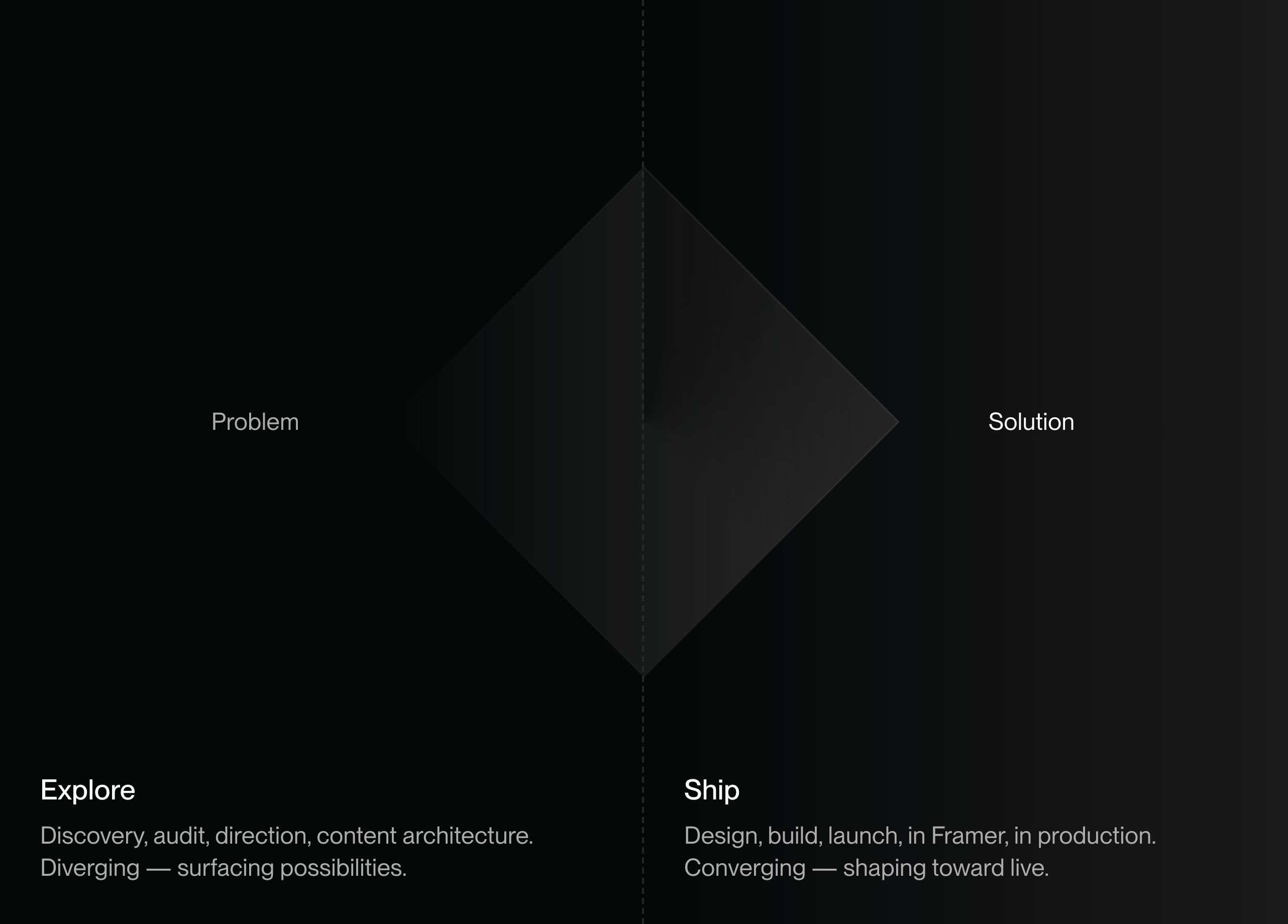
We work in one diamond. We design where the site actually lives. The design is the build. Discovery and shipping happen in the same motion.
The Trueform Diamond has two halves:
Explore. Discovery, audit, direction, content architecture. The diverging half, where we surface possibilities directly inside Framer.
Ship. Design, build, launch, all in Framer, all in production. The converging half, where we shape toward live.
What this removes: the Figma rebuild, the scope-creep discovery phase, the inevitable "the dev version doesn't match the design" round of revisions. The average client kickoff happens within 5 business days of signing. 100% of the work happens in Framer. There is no rebuild, ever, because there's nothing to rebuild from.
What this means for what we offer
We ship four kinds of work, in Framer except where noted:
Flagship Site (8 to 16 weeks). A Framer site built like Miro's. Multi-product, multi-language, complex CMS, custom interactions. The Framer site for companies operating at real scale, built by the same team behind Miro.
Marketing Site (4 weeks). A Framer site your marketing team runs. Full homepage, product, pricing, and about pages, designed to convert and built so your team ships campaigns without engineering or us after launch.
Landing Page (2 weeks). A single Framer page or microsite that earns its traffic. For launches, fundraises, campaigns, and paid acquisition. Conversion-led, shipped in two weeks.
Platforms. Web app and product surfaces beyond Framer. When the work is bigger than a marketing site, we build the actual product surface with the same taste-first, ship-fast principles.
Every tier comes with what most agencies treat as add-ons: top Lighthouse scores, SEO and AEO baked in, a CMS your team can actually run, and an optional migration of your old content fully handled. The bar doesn't move with the price.
Frequently Asked Questions
Who won the Framer Best Big Site Award 2025?
Trueform won the 2025 Framer Best Big Site Award for its work on miro.com. The category recognizes the year's strongest large-scale Framer website, one that holds up across hundreds of pages, deep navigation, and ongoing team-driven iteration.
What is Trueform?
Trueform is a Framer-native digital studio. We design and ship marketing websites, landing pages, flagship sites, and product platforms for modern B2B SaaS companies. Framer features us as a Featured Framer Expert, and we built the site that won Best Big Site 2025. Clients include Miro, Framer, Eden, Bilt Rewards, and Morning Brew.
Why did Miro move its website to Framer?
Miro's design team was bottlenecked by the traditional model, where every page change required engineering, which slowed launches and localizations. Framer let Miro's designers ship pages independently, while still maintaining global localization, performance, and a coherent design system at scale.
What is the Trueform Diamond?
The Trueform Diamond is our methodology. Most agencies use the double diamond, designing in Figma and rebuilding in code. We use a single diamond: we design where the site actually ships, inside Framer. Discovery and delivery happen in the same motion. No Figma rebuild, no handoff phase, no scope-creep discovery.
How long does a Framer build like Miro's take?
A Flagship Site at Miro's scale takes 8 to 16 weeks depending on scope, localization needs, and CMS architecture. A standard Marketing Site ships in 4 weeks. A Landing Page or microsite ships in 2 weeks. Compared to engineering-led builds that take 6 to 12 months, these timelines are dramatically faster without trading off design quality.
Can you build a site this complex in Framer without a specialist agency?
Technically yes; practically no. Framer is powerful enough to run sites the size of Miro's, but doing so requires deep familiarity with Framer's CMS architecture, component patterns, localization model, and performance characteristics. The gap between Framer works and Framer works at Miro's scale is where Framer-native studios earn their keep.
What's next
Winning Best Big Site 2025 is the loudest validation we could ask for of how we work, but the work is the point, not the trophy. If you're a B2B SaaS team thinking about your marketing site, a flagship rebuild, or a launch page that needs to ship in two weeks, let's talk.


